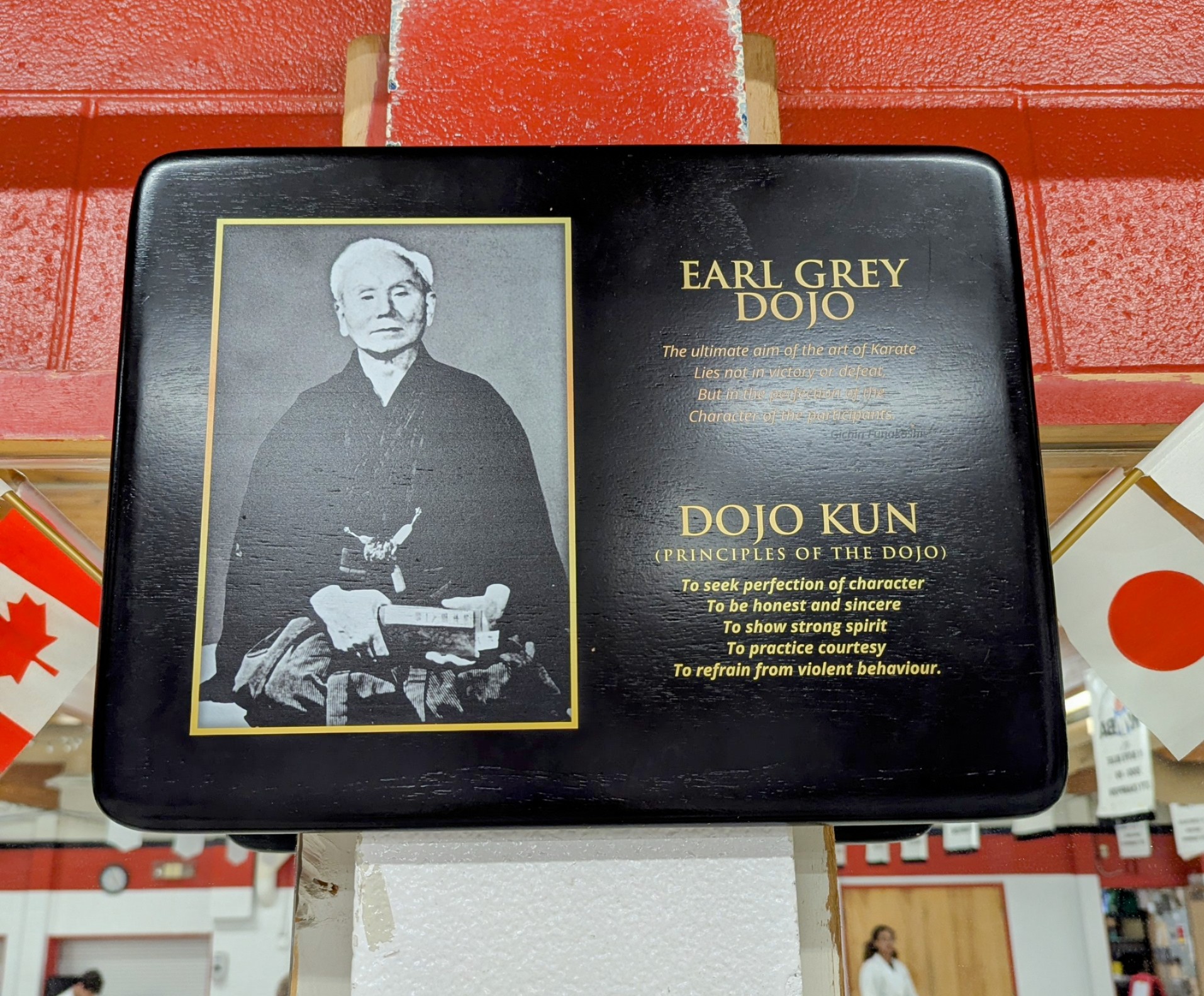
MASTER NISHIYAMA once referred to Marr Sensei as a pioneer for promoting and developing Traditional JKA Shotokan Karate in Canada. The development and success of present-day Traditional JKA Shotokan, specifically in Manitoba, Saskatchewan, and Alberta, is due largely to the efforts of Marr Sensei.
In the late 1950s and early 1960s, Marr, a shodan in Judo, was training and teaching at the Manitoba Judo Club. However, after sustaining a dislocated collar bone and separated shoulder, he found it difficult to continue Judo practice. One of Marr Sensei’s first Judo instructors was Mr. Ron Fulton, who had trained under a former British Commando unarmed combat instructor and passed that knowledge on to Marr.
Marr’s early judo included striking, hitting, and kicking techniques similar to those used in Karate. These techniques intrigued him, and he decided to pursue Karate. At the time, Karate was new to Canada, and Marr had to find a way to get instruction. He purchased Nishiyama Sensei’s book, Karate – The Art of Empty Hand Fighting, for $10.00 and began studying on his own.
In May 1963, Marr was approached by Mr. Roy Roberts, a Judo-ka with limited Karate knowledge. Roberts offered to teach Marr, who trained under him daily for four months using Nishiyama’s book as a reference. Marr also trained privately in Kung-Fu in a Winnipeg Chinatown basement.
That fall, Marr read an article in The Star Weekly about Shotokan Karate and Ary Anastasiadis of the JKA. Anastasiadis, who was heading to Japan, agreed to visit Winnipeg on his return. Marr’s introduction to JKA Shotokan Karate began there.
In December 1962, Anastasiadis was officially recognized by the Honbu Dojo to represent JKA in Canada. Marr traveled to Montreal to train with him and, with the Manitoba Judo Club’s approval, began teaching JKA Karate. A Wado-Ryu black belt named Aki Yamaguchi trained with Marr, and they exchanged knowledge between styles. Yamaguchi promoted Marr to 4th Kyu before leaving.
Richard “Tug” Wilson, a friend and Karate-ka, informed Marr of a tournament in Minneapolis led by Robert Fusaro, a JKA Shotokan instructor. Marr entered, met Fusaro, Nishiyama, and other Japanese masters. In November 1964, Marr began formal training with Fusaro in his living room, forming a 50-year friendship.
Marr traveled to Minneapolis regularly using his vacation time and began teaching students in Winnipeg. He opened his own dojo in 1964, “Midwest Karate Club,” named after Fusaro’s dojo. He also worked to form a Canadian JKA organization, staying in contact with Nishiyama and Okazaki.
In 1968, Marr was promoted to Shodan by Master Nakayama at a Minneapolis seminar. By 1969, he became a full-time instructor with over 250 students. Visiting instructors like Okazaki and Yaguchi helped expose students to high JKA standards. Fusaro’s students and others also visited to teach.
At the 1971 U.S. Nationals, Marr and Reynald LeBeouf were appointed to lead the JKA in Western and Eastern Canada, respectively. This unity brought success but also changes over the years.
In 1974, Nakayama promoted Marr to Sandan in Winnipeg. In 1980, the JKA International of Canada was formed, with Nishiyama as technical advisor. In the early 1980s, Katsumata Sensei moved to Montreal and became Chief Instructor for Eastern Canada, while Marr led the West. Despite Katsumata’s eventual transition to JKS, their relationship continued, and he still conducts seminars across Western Canada.
Marr received instruction from many renowned JKA instructors, including Nakayama, Nishiyama, Okazaki, Mikami, Yaguchi, Mori, and others. Still, he credits Fusaro Sensei as having the most profound impact on his training.
Sensei Chris Smaby of Iowa, a longtime friend, worked with Marr on unique self-defense demonstrations involving nerve and pressure point techniques (Kyusho).
Thousands of students have trained at Midwest Karate, too many to list. Marr thanks them all. Senior student Don McKenzie (7th Dan) teaches in Winnipeg. Sons Darren (6th Dan) and Jarrett (4th Dan) also teach. Other notable students include Donece Greg (4th Dan), Dick Staples (5th Dan), and Dale Carlson (5th Dan).
Technical requirements for ranks combine the JKA-US and JKS grading syllabi. Competitions follow traditional and original JKA rules. With decades of dedication, Marr Sensei has become a master of his art. He emphasizes that adaptability is the key to success: “There are no what-ifs. If something changes, we change. We continue to change and evolve,” he says. “This approach is today’s modern karate!”
 Midwest Karate Earl Grey